

The Platform Is the Product, Part III: The Economics of the Platform
In the first two parts of The Platform Is the Product, we explored how Corporate IT is evolving from a centralized technology gatekeeper into the steward of a shared enterprise platform, and why Identity and Access Management provides the control plane that makes that transformation possible.
But enabling more people to build introduces another challenge.
Someone still has to pay for it.
Cloud computing makes technology incredibly accessible, but it also changes the economics of IT. Infrastructure that once required months of planning and capital investment can now be provisioned in minutes. AI introduces an entirely new class of consumption-based services where costs can increase quickly as experimentation turns into production use.
This makes financial governance an architectural concern.
The objective should not simply be to make cloud computing cheaper. It should be to create a platform where the organization understands what it is consuming, what that consumption costs, who owns it, and ultimately what value it creates.
A mature platform doesn't just make technology easier to consume. It makes the economics of that consumption visible and manageable.
Build Something Worth Paying For
Before discussing chargeback models, cost allocation, tagging strategies, or FinOps practices, there is a more fundamental principle worth addressing.
Build something the business actually wants to use.
I have seen organizations introduce internal chargeback mechanisms before establishing a platform that provides meaningful value to its users. Business units are suddenly asked to carve out budget for technology services that are difficult to access, slow to provision, or poorly aligned with what they actually need.
That does not create accountability.
It creates friction.
Corporate IT has traditionally been managed as a cost center. Moving toward a platform model creates an opportunity to change that relationship, but the change has to begin with value.
The platform should make it easier for people to solve problems.
If a business user can request access to a sandbox and begin experimenting with an AI service the same day, that has value.
If an analyst can deploy a small application without waiting weeks for infrastructure, that has value.
If a data science team can obtain the compute capacity it needs while remaining inside enterprise security and financial boundaries, that has value.
Only after the organization trusts the platform as a useful product does it make sense to have a meaningful conversation about how its costs should be funded.
IT earns the right to allocate cost by first delivering something the business values enough to consume.
Establish Platform Consumption Tiers
Not every user needs the same platform.
Some employees may simply want an environment where they can experiment with managed AI services or explore an idea.
Others may need to host a lightweight Python application that integrates with enterprise data.
A data science team may require GPUs, high-performance compute, large datasets, and long-running workloads.
Trying to serve all of these users through a single service model either creates unnecessary restrictions for simple use cases or insufficient governance for complex ones.
Instead, establish clear consumption tiers.
For example:
Sandbox
Designed for experimentation, learning, and prototyping.
A sandbox environment might provide:
- Access to approved cloud and AI services
- Limited compute and storage
- No production data
- Defined spending limits
- Automated shutdown or expiration
- Limited connectivity to production systems
The goal is to make the barrier to experimentation extremely low.
Managed Application
Designed for applications that need to operate reliably beyond experimentation.
This tier may introduce:
- Production hosting
- Enterprise integration
- Monitoring and alerting
- Backup and recovery
- Security scanning
- Defined support expectations
- Departmental funding
Advanced Compute
Designed for workloads with specialized or significant consumption requirements.
This may include:
- GPU workloads
- Machine learning
- Large-scale analytics
- High-performance computing
- Specialized storage
- Higher consumption limits
These workloads require greater financial visibility because a relatively small number of users can generate significant costs.
The platform is still one product, but users consume it through offerings that reflect different levels of risk, capability, and economic responsibility.
Subsidize the On-Ramp
The ability to innovate should not be limited to the best-funded areas of the organization.
Many users will not understand what the platform can do for them until they have an opportunity to use it.
For that reason, the entry-level offering should be inexpensive—or, in many organizations, centrally funded.
A business user should not need to establish a new departmental budget simply to experiment with an idea.
The onboarding process should be simple: request access, provide a business justification, obtain the appropriate approval, and begin working within a predefined set of guardrails.
That initial allocation does not need to be large.
A sandbox might receive a modest monthly budget that is sufficient for experimentation but small enough to limit financial risk.
Once an experiment becomes a meaningful application or begins consuming significant resources, the funding model can change.
This creates a natural progression:
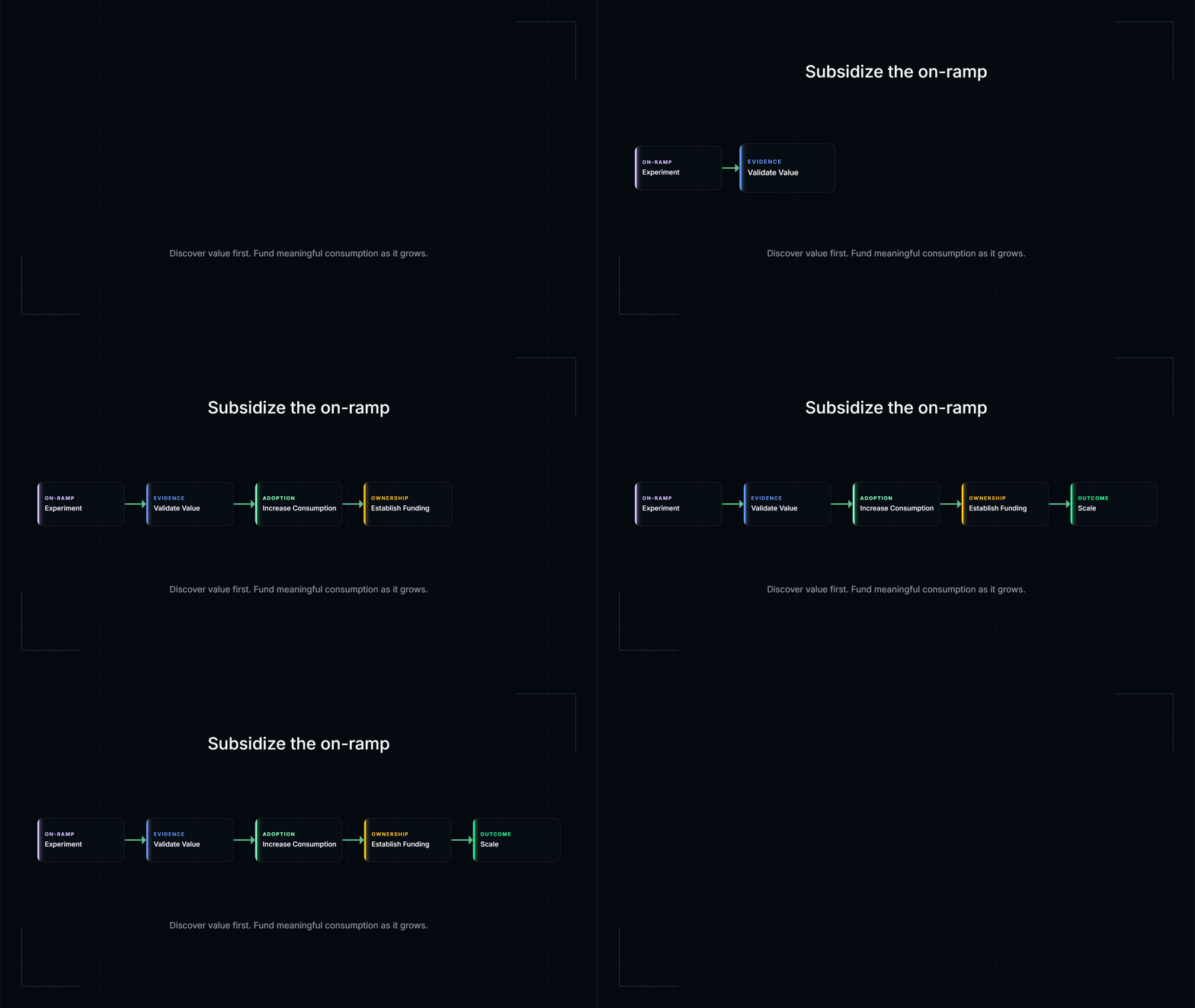
The platform enables the organization to discover value before requiring the business to commit significant resources.
People cannot discover the value of the platform if the financial barrier prevents them from ever touching it.
Everything Has an Owner
In Part II, we established that every identity and entitlement should have an owner.
The same principle applies to the economics of the platform.
Every workload, resource, and dollar should be attributable to someone.
At a minimum, the platform should be able to answer:
- Who requested this resource?
- Who owns it today?
- What application or business capability does it support?
- Which department or cost center is responsible for it?
- Which environment does it belong to?
- Why does it exist?
- How much does it cost?
A useful ownership hierarchy may look something like:
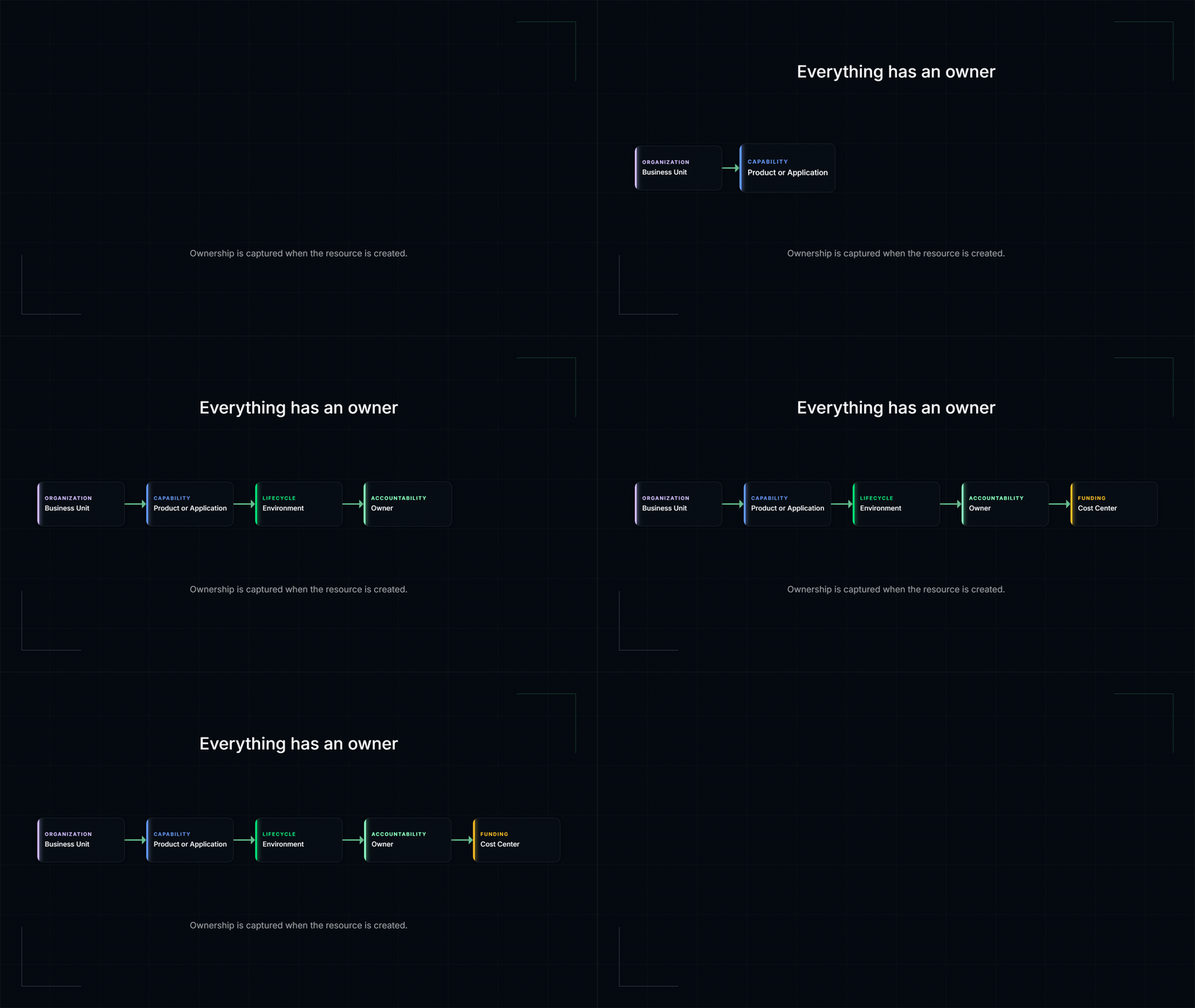
The exact implementation will vary between organizations. Cloud accounts, subscriptions, projects, resource tags, Kubernetes labels, and platform metadata can all contribute to the model.
The important part is that ownership is established when the resource is created—not months later when someone is trying to understand an unexpected bill.
Requests for platform access should also be tracked.
Capture the requestor, department, owner, business justification, approval, and expected purpose of the environment.
That information creates an audit trail, but more importantly, it connects technology consumption back to the reason the organization approved it in the first place.
Showback Before Chargeback
Financial accountability begins with visibility.
Before sending a business unit a bill for its cloud consumption, give it the ability to understand that consumption.
Users and managers should be able to see:
- Current spend
- Forecasted spend
- Spend by application
- Spend by environment
- Spend by team
- Major cost drivers
- Budget utilization
- Significant changes in consumption
This is where showback becomes incredibly valuable.
A team may not initially be responsible for paying its cloud costs directly, but it should still understand what those services cost.
That visibility changes behavior.
A team that discovers its development environment costs $8,000 per month may decide that shutting it down outside business hours is worth the effort.
Another team may discover that a $20,000 monthly AI workload is generating hundreds of thousands of dollars in operational value and decide that increasing the investment is entirely justified.
Both outcomes are healthy.
The objective is not to make every number smaller.
The objective is to make the economics visible enough that people can make informed decisions.
Chargeback may eventually make sense for certain services, departments, or consumption tiers.
But transparency should come first.
You cannot create financial accountability around costs people cannot see or understand.
Build FinOps Into the Platform
Cost governance should not be something added after the platform has already grown.
It should be part of the architecture from the beginning.
Before the first workload is provisioned, the platform should understand:
- Who owns it
- How its consumption will be measured
- Where its costs will be attributed
- What budget applies
- What financial limits should be enforced
- How anomalies will be detected
- How costs will be reported
This requires a consistent resource-allocation and tagging strategy.
It also requires automation.
Every resource created through the platform should inherit the metadata necessary to understand its ownership and purpose.
The goal is to reach a point where someone can look at the organization's cloud bill and trace meaningful portions of that spend back to a business capability.
Not simply:
AWS costs $500,000 this month.
But:
This application costs $38,000.
This data platform costs $72,000.
This department consumed $95,000.
This AI workload costs $4.20 per completed business transaction.
That is where cloud cost becomes useful business information rather than simply an invoice.
Automate the Financial Guardrails
There is a dangerous way to implement cloud governance.
Every request becomes a ticket.
The employee submits the ticket.
A manager approves it.
IT reviews it.
Finance reviews it.
A cloud engineer provisions the environment.
Several days later, the user receives access.
Technically, the organization has governance.
It has also recreated the gatekeeper.
The platform should enforce financial controls automatically wherever possible.
That may include:
- Budget thresholds
- Spending alerts
- Approved regions
- Maximum resource sizes
- GPU quotas
- Storage limits
- Automatic shutdown schedules
- Sandbox expiration
- Required ownership metadata
- Approved services
- Restrictions based on data classification
- Cost anomaly detection
When those controls are embedded into the platform, the onboarding experience can become dramatically simpler.
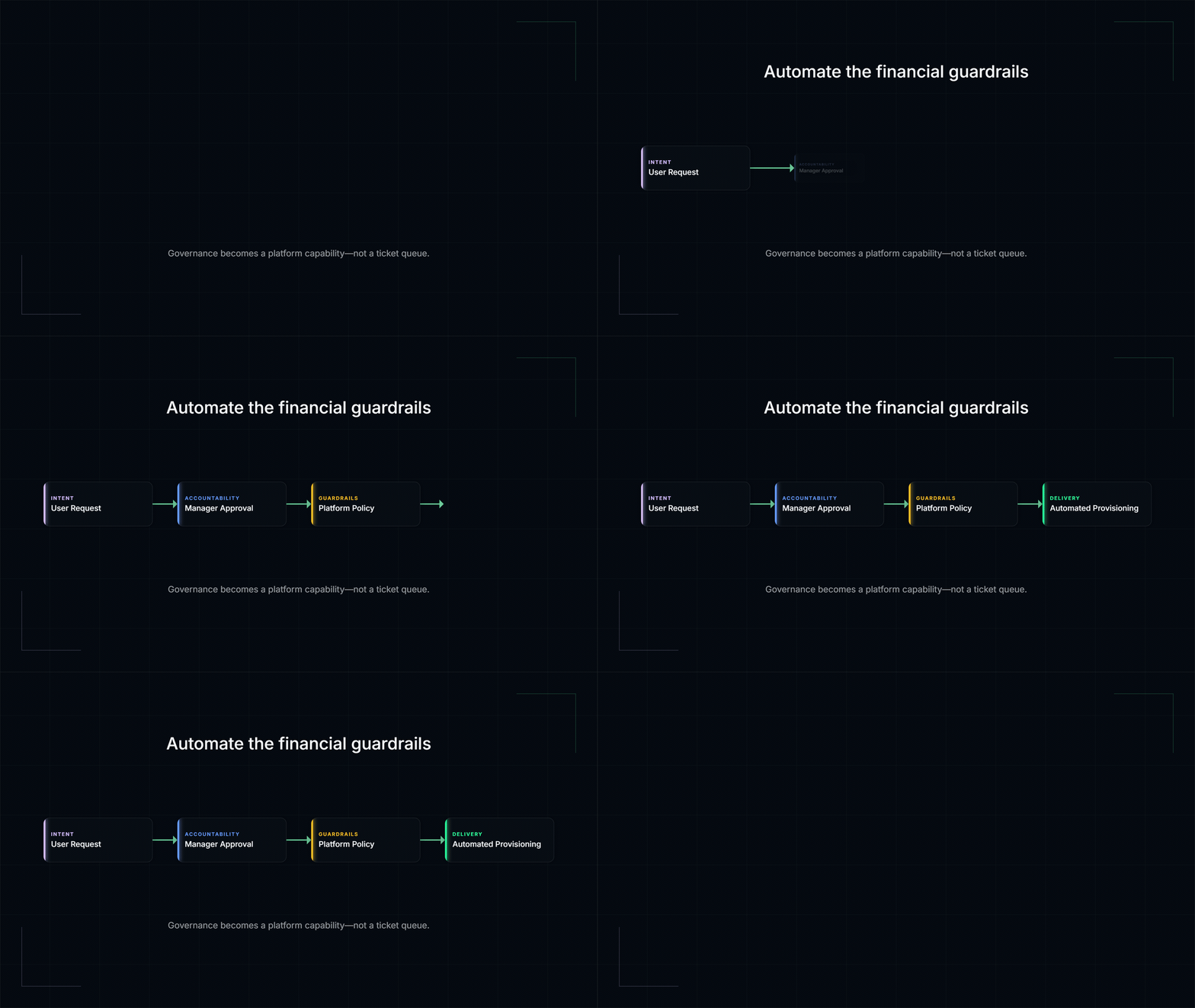
The platform—not a collection of manual approvals—becomes the mechanism through which governance is enforced.
This is one of the most important ideas behind The Platform Is the Product.
The goal is not less governance.
It is governance implemented in a way that does not require IT to stand in the middle of every transaction.
Optimize for Value, Not Cost
One of the easiest mistakes to make with FinOps is turning it into a cloud cost-reduction program.
Cost matters.
Waste should absolutely be eliminated.
Idle resources should be shut down. Oversized infrastructure should be corrected. Unnecessary storage should be removed. Commitments and pricing models should be optimized where appropriate.
But the cheapest cloud environment is not necessarily the best one.
A workload that costs $100,000 per year and creates $2 million in measurable business value may be an excellent investment.
A workload that costs $5,000 per year and provides no meaningful value is still waste.
The question should not simply be:
How do we spend less?
It should be:
What are we receiving in return for what we spend?
That requires IT and business stakeholders to evaluate technology investments together.
Cost, speed, reliability, security, and business value are all part of the same decision.
Sometimes the financially responsible decision will be to reduce consumption.
Sometimes it will be to spend more.
Measure Unit Economics
As the platform matures, total cloud spend becomes less useful as a standalone metric.
Knowing that your organization spends $3 million per year on cloud infrastructure tells you very little about whether that money is being used effectively.
Unit economics provide a better perspective.
Instead of asking:
What does this application cost?
Ask:
What does it cost to process one contract?
What does it cost to generate one forecast?
What does one AI interaction cost?
What does it cost to support one customer?
What does it cost to complete one automated business process?
The progression looks something like this:
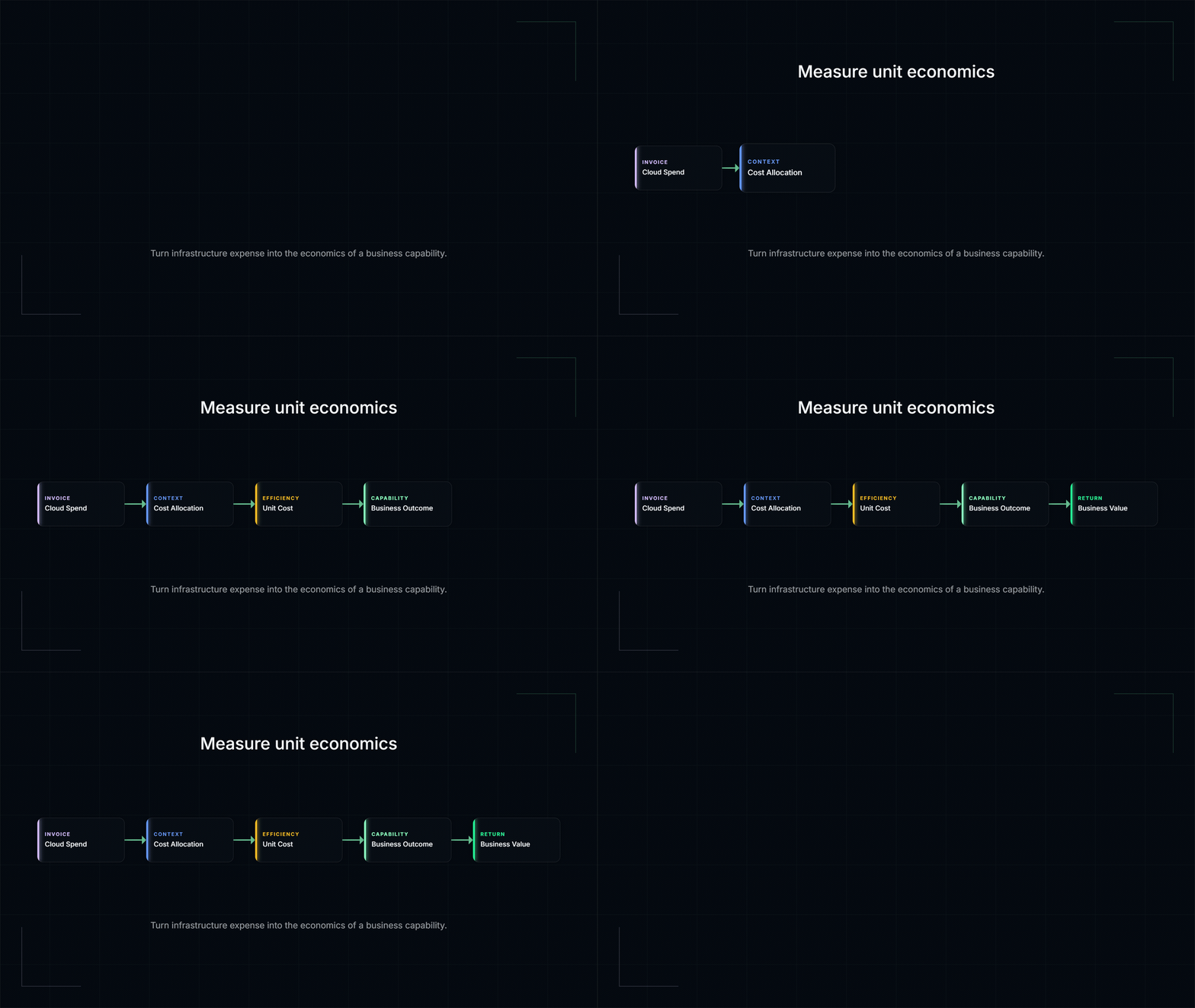
This is where the conversation changes.
Cloud infrastructure stops being a technical expense and becomes part of the economics of delivering a business capability.
That is a much more useful conversation for both IT and business leadership.
Treat Shared Capabilities as Platform Investments
Not every platform cost needs to be divided into tiny pieces and charged back to the business.
Some services exist because the enterprise needs them.
Identity.
Networking.
Security tooling.
Observability.
CI/CD.
Developer tooling.
Platform engineering.
Shared integration capabilities.
These are foundational investments that make everything else possible.
Attempting to distribute every dollar of shared platform cost through increasingly complicated allocation formulas can create more administrative overhead than business value.
The organization should understand those costs, but it can make an intentional decision to fund certain capabilities centrally.
A simple way to think about it is:
The enterprise funds the road. Consumers increasingly pay for the traffic they create.
The organization funds the foundational capabilities required to make the platform secure and usable.
Business units become financially accountable for the incremental consumption generated by their workloads as those workloads mature and scale.
The exact balance will vary between organizations.
What matters is that the funding model is intentional, understandable, and aligned with the behavior the organization wants to encourage.
The Economics Are Part of the Product
A successful enterprise platform should make technology easier to consume.
A mature enterprise platform should also make that consumption easier to understand.
Who owns it?
What does it cost?
Why does it exist?
What value does it create?
Those questions should not require weeks of analysis or a spreadsheet assembled once a quarter.
The answers should be part of the platform.
This is why FinOps, cost allocation, budgeting, ownership, and consumption reporting cannot sit entirely outside the engineering organization. They are part of the architecture.
The goal is not to transform Corporate IT into an internal billing department.
It is to establish a healthier economic relationship between technology and the rest of the business.
Build something useful.
Make it easy to consume.
Give people room to experiment.
Make the costs visible.
Establish ownership.
Automate the guardrails.
And as consumption grows, connect the investment back to the value it creates.
The platform earns trust by making innovation easy. It earns investment by making its value visible.
That is the transition from technology as overhead to technology as a measurable business capability.
And that is when the platform truly becomes the product.